TEACHING & LEARNING SERIES

Stay tuned for 2026-27 series information!
2025-26 TEACHING & LEARNING SERIES
WHY SUBSCRIBE TO A SERIES?
Professional learning is a community activity! As a member of the series, ALL teachers and leaders in your school may participate in all programs, which is a great cost savings to your school. Since all programs are virtual, there are no hidden transportation costs and participants may either engage live or view the recordings asynchronously.
Use this series to promote professional development for 2025-26! View the programs as a division group live or the recording, ask that teachers view and reflect on a certain number of programs in the series, and/or use the information to launch pedagogical discussions among your teachers. The ideas are endless! The series provides easy access for colleagues to hear the same message and you will meet expert presenters from the national scene.
Series are open to PAIS member schools only. Schools that do not register for the series may have participants register for individual programs for $50 per participant per program. See below to check if your school has registered for the series.
ACT 48 credits available for all Teaching & Learning Series programs. In order to receive the credits, participants must be present for the live program. A survey to assess learning will be sent to complete.
COST:
$580 for schools less than 200 students
$795 for schools between 201-500 students
$995 for schools more than 500 students
Each school will select a point person for communication purposes and to serve as a liaison between the school and PAIS.
SESSION DETAILS:
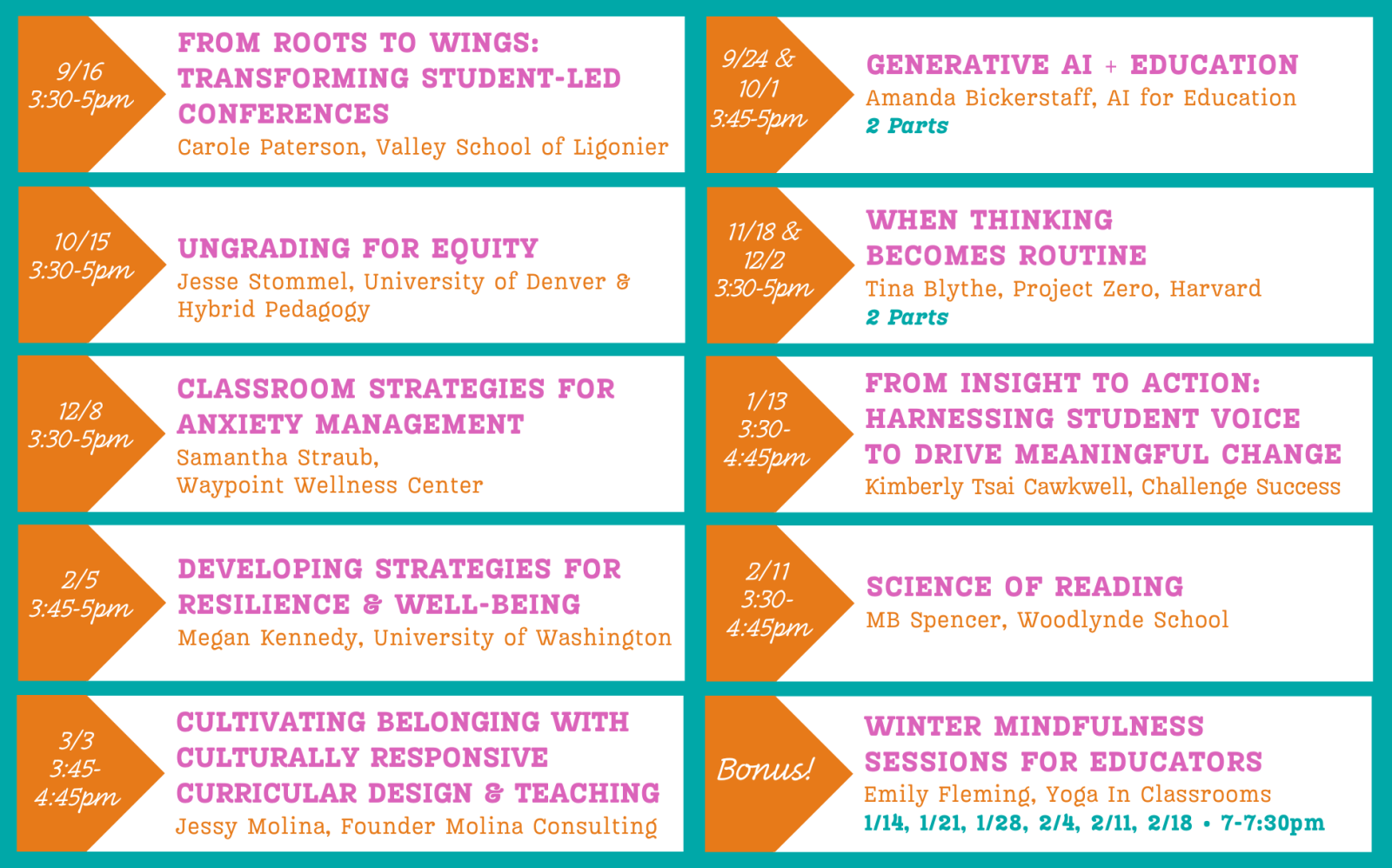
From Roots to Wings: Transforming Student-Led Conferences
Student-Led Conferences as a partnership between students, teachers and families
September 16, 3:30-5pm • Presenter: Carole Paterson, Valley School of Ligonier
Audience: Upper Elementary - Upper School teachers, advisors, and academic leaders
What if student-led learning wasn’t just an event, but a mindset woven throughout each school year—and across every grade level of a school? Whether you are new to Student-Led Conferences or looking to revamp your approach, this workshop will provide actionable strategies to inspire and build momentum. We will explore how to develop intentional Learning Partnerships between students, advisors (HR teachers), and families as a robust foundation for support. In our time together, we'll focus on tools and strategies to help students identify their strengths and challenges, reflect honestly, and gradually take ownership of their learning journey.
Anchored in research-based techniques and first-hand experience, this session is ideal for educators, advisors, and school leaders who want to enhance student agency, improve family engagement, support faculty growth, and create coherent structures for personalized learning. Together, we will review a framework that can adapt and flex to meet the unique needs of students, faculty, and administrators while fostering a culture where student voice isn’t a moment—it’s the norm.
Generative AI + Education
A two-part program exploring AI literacy for students and tools
September 24, 3:45-5pm, Part 1 • October 1, 3:45-5pm, Part 2 • Presenter: Amanda Bickerstaff, Co-Founder and CEO of AI for Education
Audience: Informative for everyone but most applicable to middle and upper school educators, Tech Directors, and academic leaders
Part 1 is a forward-thinking workshop designed to equip educators with the knowledge and tools necessary to prepare students for an AI-driven future. This comprehensive session empowers teachers to cultivate essential AI literacy skills, ensuring students can navigate, critically evaluate, and ethically engage with AI technologies in their academic, personal, and future professional lives. Includes AI Literacy Fundamentals, Essential AI Skills for Students, Understanding AI’s capabilities and limitations, and Curriculum Integration Strategies
Part 2 focuses on AI tool exploration. Topics include:
- Exploration of a variety of AI tools: Explore a diverse array of accessible AI tools for research, concept mapping, image generation, audio/video production and more that can enhance both teaching practice and student learning.
- Hands-on experience Create GenAI outputs with a variety of tools, such as Notebook LM, Napkin.ai and Canva Magic
- Implementation Pathway: Master the progression from personal tool exploration to effective classroom integration through: modeling effective AI tool use, co-creation opportunities with students, and strategies for responsible classroom implementation
Ungrading for Equity
Designing assessments that are flexible, nurture intrinsic motivation, and support true learning
October 15, 3:30-5pm • Presenter: Jesse Stommel, University of Denver & Hybrid Pedagogy
Audience: Middle and Upper School teachers, DEI Directors, and academic leaders, but interesting for all.
“Ungrading” means raising an eyebrow at grades as a systemic practice, distinct from simply not grading. The word is a present participle, an ongoing process, not a static set of practices. Too many of our approaches to grades treat students like they’re interchangeable and fail to recognize their complexity. Can we imagine flexible approaches to assessment, pedagogies which center intrinsic more than extrinsic motivation, encouraging and supporting learning, rather than policing behavior? We have to design for the least privileged, most marginalized students, the ones more likely to have felt isolated even before the pandemic: disabled students, chronically ill students, Black students, international students, queer students, those facing housing and food-insecurity, etc. We need to write policies, imagine new ways forward, for students already struggling, already facing exclusion. In this talk and workshop, we'll examine the foundations for our pedagogical approaches, consider the history of grades, examine the bias inherent in many of our standardized systems, and explore methods and approaches for designing assessments that push back against traditional notions of grading. The event will balance presentation with activities and discussion.
When Thinking Becomes Routine
Using Thinking Routines as More than Activities
November 18, 3:30-5pm, Part 1 • December 2, 3:30-5pm, Part 2 • Presenter: Tina Blythe, Director of Learning and Outreach at Harvard Project Zero
Audience: PreK - 12th grade educators and academic leaders
For many years, Project Zero researcher-educators have developed a number of thinking routines that encourage students to look closely, to seek connections, to uncover complexities, to reason with evidence, and to consider perspectives. When used powerfully, thinking routines not only provide teachers with a set of practices to engage students, but help advance a broader goal to create classrooms where students’ thinking is visible, valued, and actively promoted. In Part One, participants will have an opportunity to consider making thinking visible as a goal of their teaching, discussing powerful practices that bring thinking to the foreground of classroom endeavors. In Part Two, participants will look at lessons we’ve learned from teachers worldwide who use thinking routines for maximum effect.
Classroom Strategies for Anxiety Management
Learn how anxiety impacts learning and leave with useful strategies to implement in the classroom
December 8, 3:30-5pm • Presenter: Samantha Straub
Audience: Teachers of all students, counselors, learning specialists, academic leaders
This workshop will empower educators with a toolkit of classroom strategies to help students manage anxiety and stay engaged. The session begins with a brief review of how anxiety affects the body and mind, helping educators understand what’s happening when students feel overwhelmed. Participants will then explore actionable techniques to cultivate a safe, connected classroom environment while maintaining high academic standards. Leave with ready-to-use strategies designed to support all students, especially those prone to anxiety, in their academic and emotional growth.
From Insight to Action: Harnessing Student Voice to Drive Meaningful Change
Learn strategies to amplify student voice, in the classroom and in your school community
January 13, 2025, 3:30-4:45pm • Presenter: Kimberly Tsai Cawkwell
Audience: Teachers of students of all ages, academic leaders
In this workshop, you will discover strategies for collecting, analyzing, and applying student experience data to create a more responsive and inclusive educational environment. We will examine survey data trends from the Challenge Success-Stanford Survey of Student Experiences, administered to over 350,000 middle and high school students, focused on student well-being, belonging, and engagement. You will learn how schools have turned insights into action to improve school policies and practices and leave ready to amplify student voices in your school community using simple, yet powerful, tools and strategies.
Learning Objectives:
- Gain an understanding of data trends from 350,000+ middle and high school students
- Make connections to your local context to highlight strengths and identify opportunities
- Learn strategies for amplify student voices in your communityDeveloping Strategies for Resilience & Well-Being
Developing Strategies for Resilience & Well-Being
A workshop focused that introduces skills and practices for promoting resilience and well-being
February 5, 2026, 3:45-5pm • Presenter: Megan Kennedy, Director, UW Resilience Lab, University of Washington
Audience: All educators, counselors, learning specialists, and academic leaders
This session offers a valuable opportunity to learn and practice evidence-based strategies for building resilience, managing stress, and enhancing overall well-being through cognitive, mindful, and compassionate approaches. Participants will learn the connection between thoughts, feelings, and behaviors and how to identify and modify unhelpful thought patterns, be introduced to the concept of present-moment awareness without judgment, and explore practices to cultivate kindness, self-compassion, and empathy towards oneself and others. The session emphasizes interactivity and will allow participants to share their experiences, ask questions, and learn from each other to build community and deepen understanding.
The Science of Reading: Bringing All the Pieces Together
SoR and how it connects with EF, SEL, and learning outside the reading classroom
February 11, 3:30-4:45pm • Presenter: MB Spencer, Administrator and teacher at Woodlynde School
Audience: Teachers of all students, learning specialists, and academic leaders
Schools are moving towards more evidence-based instruction in literacy within the framework of the Science of Reading, but the impact of literacy and reading delays don't stop at the classroom door. Join us to discuss how teachers of content areas, administrators, and counselors can thoughtfully consider how to support SoR and understand reading disabilities in the whole student.
Cultivating Belonging with Culturally Responsive Curricular Design and Teaching
March 3, 3:45-4:45pm • Presenter: Jessy Molina, Founder Molina Consulting
Audience: Teachers of all students, DEI Directors, academic leadership
This training will guide educators in understanding culturally responsive teaching and how to apply culturally responsive teaching strategies to affirm students' family cultures, prior knowledge, and experiences in order to deepen students' access to academic skills and content. Through the "windows and mirrors" framework, participants will critically examine their curriculum to identify which histories, stories, viewpoints, and perspectives are present and absent. We will explore the messages the curriculum sends to students, families, and communities, and discuss ways educators can reimagine their curriculum to foster a stronger sense of self and belonging for all students.
BONUS: Winter Mindfulness Sessions for Educators
Practice mindfulness during the dark days of winter. Join one or all sessions to rejuvenate yourself and build connection in community with others.
Wednesdays, 7-7:30pm • Presenter: Emily Fleming, Founder, Yoga In Classrooms
- January 14 • Mindfulness in Community
- January 21 • Mindfulness as Self-Inquiry
- January 28 • Mindfulness to Self-Soothe
- February 4 • Mindfulness, Joy, and Gratitude
- February 11 • Mindfulness for Self-Confidence
- February 18 • Mindfulness for Self-Compassion
CLICK HERE TO SEE ALL PRESENTER BIOS
The following schools are part of the 2025-26 series:
Academy of Notre Dame de Namur, Ancillae-Assumpta Academy, Falk Laboratory School, Friends' Central School, George School, Germantown Academy, Holy Child Academy, Hope Partnership for Education, Jack M. Barrack Hebrew Academy, Lancaster Country Day School, Mount Saint Joseph Academy, Pen Ryn School, Plymouth Meeting Friends School, Sacred Heart Academy Bryn Mawr, Sanford School, Shady Side Academy, Solebury School, St. Joseph's Preparatory School, The Agnes Irwin School, The Baldwin School, The Ellis School, The Janus School, The Miquon School, Villa Maria Academy High School, Westtown School, William Penn Charter School, Winchester Thurston School, Woodlynde School
WHAT'S AHEAD

DISCOVER UPCOMING SIGNATURE PROGRAMS!
Emerging Leaders Institute
Professional Growth Visits
FOLLOW US!